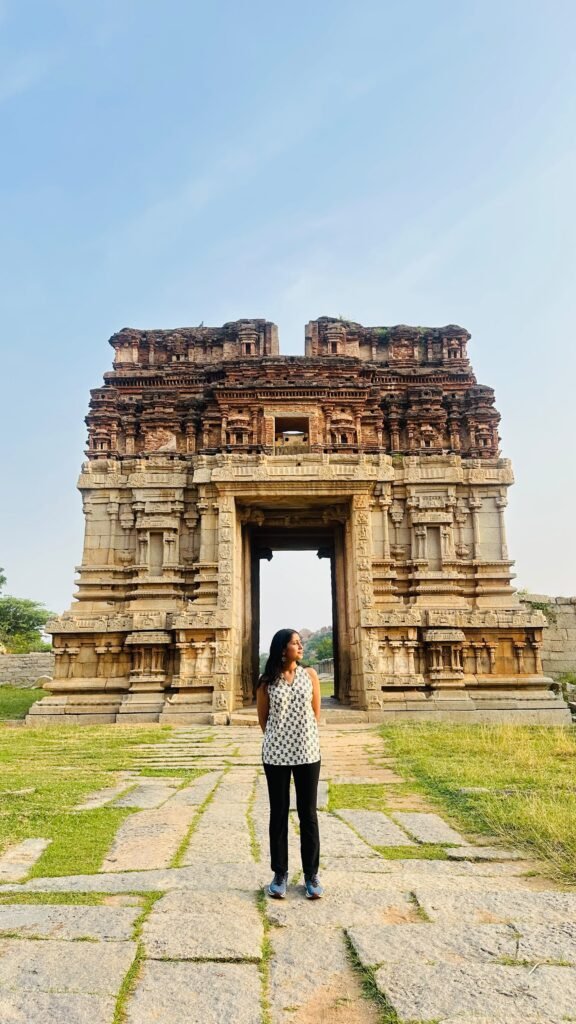
Hampi: Where the stones sing, the river whispers, and history meets geography
2–5 October · A four-day trip from Bengaluru
Some places leave you with photographs. Others leave you with a slightly different way of looking at the world. Hampi, for me, managed to do both.
Day 1: A fort, a few monkeys and a sunset I didn’t want to leave
We left Bengaluru at around nine in the morning on 2nd October, with four people, a car and the excitement that usually accompanies a road trip. Our first stop was Chitradurga Fort, where we decided to stretch our legs and explore the ruins for a little while.
The fort was beautiful, but the monkeys were perhaps the most enthusiastic residents. We encountered quite a few of them, which, as we would soon discover, was going to be a recurring theme throughout our trip. Hampi had its own little monkey population waiting for us.
The scorching afternoon heat, however, wasn’t particularly encouraging. We explored for a while, stopped for lunch and continued towards Hampi.
By the time we arrived in the evening, the weather had softened considerably. The skies were prettier, the air was more pleasant, and our stay turned out to be quite lovely. We were staying in tent-style rooms, surrounded by paddy fields, with a small lake nearby and, most importantly, the cutest dog imaginable.
After the long drive, none of us had the energy to do anything particularly ambitious. So we decided to take a short five-minute walk to the Tungabhadra Left Canal.
It was, technically, just a canal — a deep stretch of water supporting the paddy fields around it. But what followed was probably the most beautiful sunset of our entire trip.
We walked through the paddy fields and reached the canal just in time to watch the sky change colours. The sunset looked like a dragon gliding across the sky. The Tungabhadra canal reflected the entire spectacle, while the enormous brown boulders scattered across Hampi seemed to catch the last of the sunlight. There was an almost alpine quality to the glow on the rocks, a strange mixture of gold, pink and muted orange.
The entire landscape seemed to turn golden and then slowly pink.
We stayed there for over an hour and a half. Nobody was particularly interested in leaving. It was one of those rare moments when you don’t feel the need to photograph everything or make conversation. You simply want to be where you are.
If I had to pick one sunset from Hampi, this would be it.
Day 2: The sun, the stones and an empire that once was
The second day began early. We were headed towards Matanga Hill to catch the sunrise and get a panoramic view of Hampi.
The climb was worth every bit of effort. Below us lay the ruins of Hampi, the scattered boulders, the temples and the remains of a city that had once been the centre of the Vijayanagara Empire.
There were crowds, of course. But as the sun began to rise, something interesting happened. People gradually became quieter. There was a certain stillness, almost a collective reverence, as everyone watched the morning light unfold over the ruins.
I found myself thinking about the sun.
It had watched the Vijayanagara Empire rise. It had watched it flourish, expand and eventually fall. It had witnessed generations of people, rulers, celebrations, wars and ordinary mornings that nobody would ever record in a history book.
And there it was, rising over Hampi as if nothing had changed.
There is something humbling about standing in a place where an empire once stood and realising that even the grandest human achievements are temporary. The sun has seen them all come and go.
After a while, we began our descent. What followed was a roughly 10-kilometre walk through the ruins of Hampi.
And when I say the heat was unbearable, I mean it.
The Hampi sun has absolutely no interest in your sightseeing plans. It will test your commitment to history, architecture and civilisation in equal measure.
But the ruins? Magnificent.
The architecture of the Vijayanagara Empire is something that photographs really cannot do justice to. The amount of patience, skill and craftsmanship that must have gone into creating these structures is astonishing. These weren’t buildings thrown together to serve an immediate purpose. They were works of extraordinary detail, built with an understanding of proportion, art and permanence.
One of the most fascinating places we encountered was the Hazara Rama Temple. The carvings, the details and the sheer intricacy of the work were incredible. There is music in the stones of Vijayanagara. If I had to describe the experience in one sentence, it would be this: the stones sing.
And then there were the temples and their fading murals.
We eventually reached the Virupaksha Temple, although the heat meant we couldn’t spend as much time there as we would have liked. We did, however, get to see the murals on the ceiling, depicting the Dashavatara of Vishnu. Even after centuries, traces of colour remained.
That was perhaps one of my favourite discoveries of the day.
We often imagine ancient architecture as colourless — brown stone, grey pillars, faded monuments. But these structures weren’t necessarily conceived that way. They were once colourful, detailed and full of visual life. The colours have faded, but the craftsmanship hasn’t disappeared.
And even in their faded state, the murals were extraordinarily detailed.
It made me wonder how magnificent these places must have looked when they were new.
Of course, no 10-kilometre Hampi expedition is complete without an unreasonable amount of sugarcane juice and coconut water. We were practically fuelled by them throughout the day. If you visit Hampi, consider this less of a food recommendation and more of a survival strategy.
By the time we finished exploring, we were exhausted. But the day wasn’t quite over.
The boulders, the dog and the sudden decision to jump into a river
We ended the day at Monkey Zone Hampi, a local outfit that conducts bouldering sessions around Hampi’s enormous rock formations.
We had gone there to check our shoe sizes. Apparently, bouldering shoes need to fit extremely tightly so that you can grip the rock properly. This was new information, and one that our feet weren’t particularly thrilled about.
By then, we had finished lunch, checked our shoes and were running out of energy.
But there was one thought occupying my mind: water.
After hours of walking under the Hampi sun, all I wanted was to jump into the Tungabhadra River.
I mentioned this to the person at Monkey Zone, and he suggested that we could combine our bouldering session the following day with a short trek, a visit to a cave and, most importantly, a jump into the river.
I was sold. Instantly.
There was very little room for negotiation after that. Everyone was equally enthusiastic about the idea, because apparently four people who have spent an entire day being roasted by the sun can agree on very few things — but jumping into a river is one of them.
We headed back to our stay, rested for a while and prepared ourselves for the next day.
Day 3: Learning to climb, learning to jump
The third morning began with bouldering.
We met the team at Monkey Zone, encountered another very friendly dog, did a quick warm-up and got started.
Bouldering is essentially climbing large rocks without ropes, using your body, balance and technique to navigate the formations. Before attempting anything, we were introduced to some of the basic techniques — how to use your fingertips, where to place your toes, how to distribute your weight, how to maintain balance and, surprisingly, how important breathing is.
The four of us took turns climbing.
It was challenging, exciting and a lot more fun than I had anticipated. There was something particularly satisfying about figuring out a route, finding the right foothold and slowly making your way upwards.
But one moment stayed with me.
There was a particular boulder that I looked at and immediately decided I couldn’t climb. I had already convinced myself that it was beyond my ability.
And then, almost immediately after saying that, I climbed it.
It was such a small incident, but it made me think about how quickly we establish limits for ourselves. Sometimes we decide that we cannot do something before we’ve even given ourselves a chance to try.
The four of us cheered each other on, celebrated the little victories and took turns attempting the climbs. It was a lovely experience, not just because of the activity itself, but because of the encouragement and camaraderie that came with it.
After bouldering, we went to a small café where we could sit for a longer time. We had lunch, rested and then set off for the trek that had been promised to us the previous day.
And this is where Hampi surprised me in an entirely different way.
The Tungabhadra: A river, a cave and a lesson in geography
We headed towards the Tungabhadra River for our trek.
Hampi’s geography is extraordinary. Enormous granite boulders, unusual rock formations, narrow passages and the river winding its way through the landscape make it feel almost otherworldly.
But as we started walking, we also began noticing something less romantic.
The river had receded considerably.
We could see the deep circular impressions and marks left behind by the water, as well as stretches of smooth granite that would ordinarily be submerged. The water level had dropped dramatically, and we were now trekking across parts of the riverbed that would otherwise have been underwater.
Our guide explained how much the river had shrunk. It was a striking reminder of how changes in water availability affect the people and landscapes that depend on it.
In cities, it is easy to become disconnected from the natural resources that sustain everyday life. Water comes through a tap, food appears in a supermarket and the systems supporting our lives remain largely invisible.
But in places where communities are closely connected to their land and water, these changes are much harder to ignore.
A river isn’t simply a beautiful landscape feature. It supports agriculture, livelihoods, ecosystems and entire ways of life.
Walking across the exposed riverbed made the effects of changing water levels feel much more tangible than reading about them ever could. It also made me think about climate change and the vulnerability of places whose cultures and economies are so deeply connected to their natural surroundings.
We trekked for almost an hour before reaching the jumping point.
The granite rocks were scorching. By then, the only thing standing between us and the water was a jump from a height — something I had never done before.
I was terrified.
But eventually, I jumped.
And it was exhilarating.
There is a very specific kind of thrill that comes from doing something that scares you, especially when you have spent the preceding few minutes wondering whether you should actually do it.
We swam for about an hour, explored a cave with water rushing through it and enjoyed the relief of finally being immersed in cool water.
The cave was fascinating. The water gushing through it had a force of its own. Later, I found myself thinking that what we had experienced might only have been a tiny fraction of the Tungabhadra’s full power — perhaps one per cent of what this mighty river could be at its strongest.
It was a humbling thought.
We eventually made our way back, tired, happy and thoroughly satisfied with the day.
That evening was quieter. We had dinner, talked and slowly began to realise that our trip was almost over.
Day 4: What Hampi taught me about history and geography
The next day, we packed our bags and began the drive back to Bengaluru.
The journey back was lovely, but somewhere between the conversations, the exhaustion and the photographs, I realised that the trip had left me with something more than memories of beautiful places.
One of the most interesting conversations happened around the dinner table. We discussed Hampi, its history, its geography and the reasons behind the rise of the Vijayanagara Empire.
And something clicked for me.
Until then, I had largely approached places through their culture, traditions, architecture and art. I was interested in what a place had to offer — its monuments, its stories, its people and its history.
But I hadn’t paid enough attention to its geography.
Hampi made me realise that you cannot fully understand a civilisation without understanding the landscape that sustained it.
The Tungabhadra River, the surrounding agricultural land, the availability of water, the fertile soil and the strategic positioning of the region were not incidental details in the story of Vijayanagara. They were central to it.
The river supported agriculture and settlement. The landscape offered natural features that shaped the city’s development and defences. The region’s geography played a role in making it an important centre of power and prosperity.
And suddenly, history began to look different.
We often study empires through their rulers, wars, architecture and political decisions. But what about the rivers that sustained them? The soil that fed them? The terrain that shaped their boundaries? The resources that made their prosperity possible?
We got to see the history, but geography helped us understand the why.
That was probably the most valuable perspective I brought back from Hampi.
A place I haven’t quite finished exploring
Four days in Hampi felt unbelievably short.
In fact, it was astonishing how much we managed to do in what felt like just two full days. From watching sunsets beside the canal and climbing Matanga Hill to walking through centuries-old ruins, attempting bouldering and jumping into the Tungabhadra, every day seemed to contain an entirely different experience.
But I also came back knowing that I hadn’t really seen enough.
The ruins are magnificent. They are the sort of places that leave you speechless, where every carving and every stone seems to have a story attached to it.
But Hampi is so much more than its ruins.
It is its people, its culture, its landscape, its rivers and the relationship between all of them. It is the geography that helped sustain an empire, the agricultural fields that continue to depend on water, the boulders that invite people to climb them and the river that has witnessed centuries of change.
I went to Hampi expecting to admire its history and architecture. I returned thinking about geography, natural resources, civilisation and the ways in which we understand the world around us.
And perhaps that is what makes travelling so worthwhile. You leave home thinking you are going somewhere to see something, and sometimes you return having learnt to see something entirely differently.
Hampi has a lot more stories to tell.
The stones sing. I think its people, its river and its landscape have plenty more to say, too.
I’ll be going back to listen.